Balatro Review: The Addictive Poker Game You’ll Love Even If You Hate Poker
Balatro Review: The Poker Game That Has Nothing To Do With Poker
I want to be upfront about something before anything else — I do not know how to play poker. I know the very basics the way everyone does, like vaguely aware that a flush exists and that a royal flush is good, but actual poker strategy, actual poker thinking? Zero. None. I went into Balatro as someone who had no business playing a poker roguelike and came out the other side about twelve hours later, still playing it, still figuring it out, and genuinely looking forward to every session. That should tell you most of what you need to know about what this game actually is. Because,e despite everything the name and the description suggest — despite the cards, the hands, the chips — Balatro is not really a poker game. It just uses poker as the language it speaks. The actual game underneath is something completely different, and once that clicks, you understand why the whole world seemed to lose its mind over it.
Roguelikes are one of my favourite genres — I’ve put serious time into some of the best the genre has to offer, and I have a pretty high bar for what makes one actually worth sticking with. Balatro is a roguelike deckbuilder made by a single developer called LocalThunk. You play poker hands to score points, beat blinds, and progress through a run. On paper, that sounds niche and slightly intimidating. In practice,e it is one of the most immediately compelling roguelikes I have booted up on PC in a long time — the kind of game where you finish a run, lose, and are already thinking about what you’re going to do differently before the defeat screen has finished loading. Coming from someone who plays a lot of these — that hook is real, and it does not let go.
I’m maybe twelve hours in and still going. This is my honest account of what those hours felt like.
It Uses Poker. It Is Not Poker
The thing that almost put me off Balatro before I played it was the poker framing. I assumed knowing poker would be a prerequisite — that I’d spend the first few hours confused about hands and rules before getting to whatever was actually fun about it. That’s not how it works at all. The game uses poker hands as a scoring system, not as a strategy layer. A flush scores more than a pair. A straight beats two pair. You don’t need to understand poker psychology or betting or bluffing — you just need to know that certain card combinations score higher than others, and the game teaches you that within the first ten minutes, whether you knew it going in or not. I went in knowing almost nothing and never felt lost because of it.
What Balatro is actually about — what it’s really, truly about — is building a system that breaks itself. You start with a normal deck of cards and a simple goal. Then you start buying things between rounds. Jokers that change the rules. Planet cards that level up specific hands so a two pair suddenly scores more than a flush if you’ve invested in it enough. Tarot cards that modify individual cards in your deck. And slowly, run by run, you stop thinking about poker at all and start thinking about something that feels more like engineering — what combination of rules, modifiers, and deck composition creates the most ridiculous score possible. That’s the real game. Poker is just the frame it hangs on.

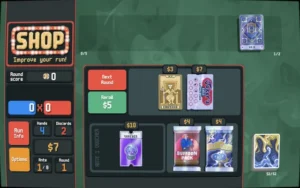
The Shop Is Where The Actual Game Lives
Between every round, there’s a shop, and the shop is where Balatro either clicks for you or doesn’t. This is where you spend your winnings on the cards and jokers that define how your run develops. Early on,n the choices feel manageable — maybe grab a planet card to level up the hand you keep landing, maybe pick up a joker that adds a small multiplier. But as your run progresses and the options get weirder, the shop becomes genuinely exciting to open. What’s in here this time?e. What combination of things could I build around this? What does this joker do if I already have that one?
The shop rewards curiosity more than it rewards knowledge. I don’t have twelve hundred hours in this game mapping out optimal build paths. I have twelve hours of experimenting, making decisions that felt right, and occasionally landing on something that worked so well I audibly reacted to it. That’s enough to have a great time in Balatro. The deeper strategic layer is there for people who want to find it, but the game is generous enough that you don’t need to go looking for it on day one.
When It All Comes Together — The Mult Run
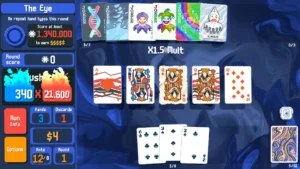
My favourite thing to do in Balatro, the thing I gravitate toward every single run, is stack multipliers. Just absolutely pile them on top of each other until the numbers stop making sense. I call it the mult — because once it starts growing, it just keeps spreading and there’s nothing you can do to stop it. You pick up one joker that adds a multiplier. Then another. Then you level up a hand with a planet card, so it’s already scoring big before the multipliers even kick in. Then something else triggers on top of that. And suddenly you’re looking at a score that has no business existing from a hand of cards that should not be doing what it’s doing.
The first time the mult really hit for me, I just said it out loud — we got the mult. Because that’s exactly what it feels like. It doesn’t feel like you planned it perfectly or executed some genius strategy. It feels like something grew. Like you planted a few things early and by the mid-run they’d taken over everything, and now the numbers on screen are genuinely alarming, and you’re just watching it happen with a big, stupid grin. That feeling — that specific feeling of a Balatro run getting completely out of control in the best possible way — is what keeps me coming back every session.
Unfortunately, my glorious mult-run ended because it was centred around using two pairs, but the boss blind disabled using one hand 2 times, so I couldn’t use a two pair again, and welp, it all went down the drain, but I learned not to store all my eggs in one basket.
Every Run Feels Different, And That’s The Point
What makes the multiplier stacking and the shop and all the build variety actually work long-term is the roguelike structure underneath it. Every run starts fresh. Every run gives you different options in the shop. The jokers that showed up last time might not show up this time, which means the build you were planning has to adapt to what’s actually available. That unpredictability is what stops Balatro from feeling like a puzzle with a correct solution. There is no correct solution. There are hundreds of different directions a run can go, and the fun is in figuring out which direction this particular run wants to take you.
I’ve had runs where the shop kept giving me exactly what I needed, and the whole thing felt effortless and brilliant. I’ve had runs where nothing connected, where I kept making reasonable decisions that somehow led nowhere, and I lost in a way that still made me think “okay, but what if I’d done this instead?” Both types of runs are interesting. The good ones feel earned. The bad ones feel like information. That’s the mark of a well-designed roguelike, and Balatro has it completely.

Just When You Think You Have It — The Boss Blind Arrives
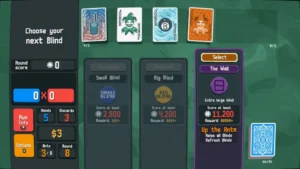
Every few rounds, you hit a Boss Blind — a harder version of the normal scoring target that comes with its own rule change to make your life difficult. Cards might come out face down, so you can’t see what you’re playing. A specific suit might be completely debuffed. The hand you’ve been relying on for the entire run might suddenly score zero. These moments are where Balatro stops being a power fantasy and starts testing whether your build actually has any flexibility or whether you’ve painted yourself into a corner.
I’ve been completely dismantled by Boss Blinds in runs that felt unbeatable five minutes earlier. I’ve also adapted to them in ways that surprised me — pivoting to a hand I’d been ignoring, using discards I’d been saving, finding out that my deck had a backup plan I hadn’t consciously built but that existed anyway because of decisions I made three rounds ago. Those moments of accidental genius are some of my favourite things Balatro has produced in my twelve hours with it. The game makes you feel smarter than you are and then occasionally reminds you that it’s still in charge.
Where Balatro Actually Sits For Me, Honestly
I want to be straight with you because I think honesty in a review matters more than hype. Balatro is not my Hollow Knight. It’s not the game I’m going to think about for years or complete multiple times, chasing 112%. It’s a different kind of game producing a different kind of enjoyment — it’s the game I boot up when I want something engaging but not emotionally demanding, something that rewards the time I put in without requiring me to be fully present in the way Hollow Knight does. That’s not a criticism. That’s a description of what Balatro actually is and why it works so well for so many different types of players.
What I can say is that twelve hours in, I’m still genuinely enjoying it and still learning things about it. I haven’t come close to exhausting what it offers. The greater difficulty stakes are still ahead of me, the joker combinations I haven’t tried yet are still out there, and every run still has the potential to turn into something I haven’t seen before. For a game made by one person, the amount of variety and replayability packed into it is genuinely staggering. LocalThunk built something that most studios with full teams would struggle to match for sheer mechanical depth and moment-to-moment engagement.
Final Verdict
Balatro is one of the most cleverly designed games I have played on PC in recent memory. I went in knowing nothing about poker, and it didn’t matter for a single second because Balatro isn’t really about poker — it’s about building something ridiculous and watching it work, about stacking multipliers until the numbers stop being numbers and start being a personal achievement, about losing a run and immediately knowing exactly what you’re going to try differently next time. The mould will grow. The scores will get out of hand. You will say things out loud to nobody in your room. That is the Balatro experience, and it is a good one.
It’s not a game that will stay with me the way my absolute favourites do — it doesn’t have that emotional weight, that world, that music that lives in your chest long after you’ve finished playing. But it doesn’t need any of that. It’s doing something completely different, and it’s doing it better than almost anything else in its genre. If you want a game that is endlessly replayable, immediately engaging, and capable of producing moments of genuine joy from a combination of cards and maths, Balatro is exactly what you’re looking for. And you don’t need to know a single thing about poker to love it.
Final Score: 8.5/10 — A masterpiece of game design from a single developer. Doesn’t need to be your favourite game to be one of the best ones you’ll play this year.
We’ll be covering every new update on kickofdraft.com as it drops — release date, gameplay details.
Play Now:

Hello! I am Mr. Sano Ethan, a content creator, variety gamer, and the driving force behind Kick Of Draft. With over 6 years of hands-on experience across PC, console, and indie gaming,
Submit your review | |