Saros Review: Housemarque Did It Again And I Am Not Okay
Saros Review: Housemarque Did It Again, And I Am Not Okay
There is a very specific feeling that only the best action games can produce. You finish a sequence, you put the controller down, your hands are shaking slightly, and your brain is still catching up to what just happened. You sit there for a second thinking —How did I survive that? Sekiro gave me that feeling. Returnal gave me that feeling so many times I lost count. Saros, Housemarque’s latest, gave me that feeling more times than either of them, and it did it faster, harder, and with more chaos on screen at any given moment than I thought was actually possible to process as a human being. This studio has been making some of the best action games in the industry for years,s and Saros is their clearest statement yet that they are operating at a level very few developers can touch right now.
It is not a perfect game. The story has real problems; some of the balancing gets uneven in the middle stretch, and there are a couple of things in the combat that genuinely frustrated me. But when Saros is firing — and it is firing for the majority of its runtime — it is one of the most electrifying experiences you can have on PS5 right now. Full stop.
Hear me out on this one.
What Saros Actually Is — And Why It Works
At its core, Saros is a procedurally generated arena shooter where you play as Arjun Devra,j fighting through waves of enemies that seem to be physically incapable of attacking you without firing enormous quantities of glowing spheres in your direction. Blue ones you can absorb. Yellow ones cause corruption and reduce your max health. Red ones you have to dodge or parry. The screen fills up with all three constantly, ly and your entire job is to move through that chaos fast enough, smart enough, and aggressively enough to come out the other side alive. It sounds overwhelming because it is. It also sounds incredible because it is.
If you played Retur,nal you already have a rough idea of what to expect here. If you didn’t — Returnal was Housemarque’s previous game, a timeloop sci-fi shooter that became one of the most talked about PS5 exclusives when it launched. Saros is built on that foundation and then builds further on top of it in almost every area that matters. The movement is sharper. The enemy variety is deeper. The systems layered on top of the core shooting are more interesting. Housemarque clearly studied everything that worked about Returnal and then asked themselves how to push it further. The answer they came up with is Saros, and it works.
The Shield and The Eclipse — The Two Things That Make Saros Special
Saros adds two major systems on top of the standard dodge-and-shoot foundation, and both of them are genuinely clever. The first is the bubble shield. When I first s, aw it I thought it seemed out of place — a defensive tool in a game that is fundamentally about moving fast and hitting hard. But the shield’s real function isn’t protection. It absorbs the energy from certain enemy projectiles and converts it into charge for your special abilities. What this means in practice is that enemy attacks become fuel. The things being fired at you constantly become a resource you want to absorb rather than just survive. That mental shift from defensive to aggressive changes how every single encounter feels, and it is one of the best mechanical ideas I’ve seen in this genre.
The second system is Eclipses. As you move through each biome, you’ll encounter a strange plant-like structure. Activating it transforms the area around you — swamps turn to acid pools, dormant machinery springs to life, enemies become more dangerous,s and their attacks shift from the absorbable blue to the corrupting yellow. Going into Eclipse mode is harder, riskier, and more demanding in every way. It is also where Saros becomes truly special. The combination of a fully charged shield, a powerful artifact build, and an Eclipse-enhanced arena produces moments of absolute controlled chaos that I will be thinking about for a long time. The game makes you want to pursue the harder path because the harder path is where the real fireworks are. That’s brilliant game design.

The Bosses — Slow Start, Absolutely Insane Finish
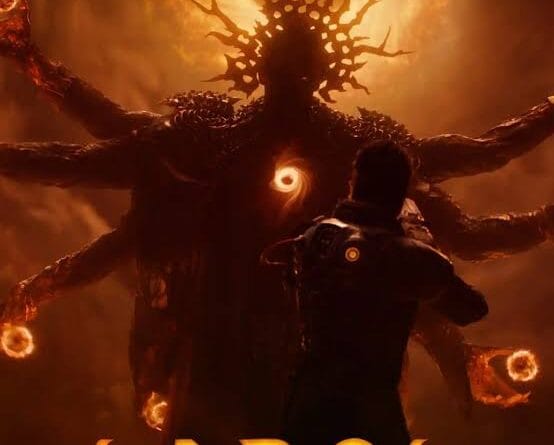
The boss fights in Saros are where the game’s spectacle pea, ks, and I want to be honest about the fact that it takes a while to get there. The first couple of bosses are visually impressive but relatively straightforward, well-designed, fun enough, but not the kind of fights that make you sit up straight and forget to breathe. There are also a couple of mid-game bosses that are essentially enhanced versions of regular enemies, which are fine without being special. If you hit those and think the boss design is just decent, keep going. Because the second half of this game is something else entirely.
The bosses in Saros’ second half are among the best-designed fights I have experienced in a game like this. Each one is built with a scale and spectacle that would work as a final boss in most other games. I genuinely thought I had completed Saros about three times before I actually saw the credits because the fights kept escalating to heights I didn’t think the game was going to top — and then they did anyway. The patience required to get through the slower early boss encounters is completely worth it for what comes later. Trust the process.
The Regular Combat Is Where Saros Really Earns Its Reputation
As impressive as the bosses are, the most significant achievement in Saros is actually how good the regular combat feels across the full length of the game. Early on, the intensity is manageable — challenging but readable. Then the game starts mixing enemy types in combinations that demand completely different approaches, and the difficulty ramps in a way that feels purposeful rather than arbitrary. There is one enemy called the Devastator — essentially an evil satellite that fires enormous sheets of projectiles from above — that I encountered early on and thought was one of the most memorable enemies in the game. Then I met the upgraded version of it later and genuinely said something out loud that I won’t repeat here. When that thing shows up, it feels like the world is ending, and it isn’t the only late-game enemy that brings that kind of energy.
Not everything in the combat is perfect. A couple of weapons — particularly the shotguns and certain variants without autohit — never felt useful enough to justify running them over better options. There is one enemy, the laser turret, that I genuinely despise. Laser attacks connect instantly, and in the chaos of a full arena fight,t it is very easy to miss the warmup animation before it fires. Getting killed by something you couldn’t reasonably see coming in a game that otherwise feels completely fair is genuinely frustrating, n,g and the laser turret produced that feeling more than once. These are real issues, not minor nitpicks. They just don’t outweigh everything the combat gets right.
The Story — The One Area Where Saros Falls Short
I want to be fair about this because I don’t think Saros has a bad story. I think it has the wrong story for the kind of game it is. Returnal understood something that Saros occasionally forgets — when the player’s attention is almost entirely occupied by processing an enormous number of projectiles at high speed, the narrative needs to be lean, immediate, and built around a small number of things the player can actually care about. Returnal centred its story on one character and a handful of genuinely gripping mysteries. Why is this planet covered in her own corpse?es. Who is this person? Why is her house here? Simple questions that hit hard and stayed interesting because they were easy to hold onto while everything else was happening.
Saros goes a different direction. It’s a more traditional sci-fi story — corporate colonialism, AI antagonists, multiple characters, timelines, audio logs, names you have to keep track of. In a slower game with room to breathe, that story would probably work well. In Saros, where ten thousand glowing projectiles are heading toward you at any given moment, it is almost impossible to keep up with who everyone is and why any of it matters. The protagonist Arjun — voiced by Rahul Kohli, who is genuinely good in the role — is also kept oddly distant from the narrative for long stretches for story reasons that eventually make sense but make him a less compelling lead than Returnal’s Selene for most of the game. There is interesting stuff happening underneath the story’s surface. It just gets lost in the noise too often.

The Roguelite Structure — Mostly Works, Occasionally Doesn’t
Saros moves away from Returnal’s full-restart-on-death approach toward a more modern roguelite structure. You teleport to the start of each zone rather than the very beginning of the game when you die, and you can spend currency earned across runs to upgrade Arjun’s permanent stats. This makes the difficulty feel more manageable and gives a clearer sense of progression between sessions. It works well overall,l even if it means you lose some of the raw tension that Returnal’s all-or-nothing structure created.
The artifact system is where the roguelite structure gets most interesting and also where it has its biggest problems. Artifacts are items you collect during a run that boost your stats and give you passive abilities — and in Eclipse mode, de they become more powerful while also adding negative modifiers that make your run harder and more exciting at the same time. Getting a full artifact build going in Eclipse mode is one of the best feelings the game produces. The problem is that in the middle section of the game,ame the rate at which artifacts appear drops significantly. Runs that should feel like an escalating power fantasy occasionally feel underpowered because the randomised loot simply didn’t give you enough to work with. It’s a balancing issue and a noticeable one. It never made the game feel impossible,ible but it did make certain stretches less fun than they should have been.
Final Verdict
Saros is not a flawless game. The story is ambitious in ways that don’t fully suit the experience around it; the laser turret can go straight in the bin, and the artifact drought in the middle section is a real balancing problem that Housemarque should address. These are genuine criticisms, and I’m not going to pretend otherwise.
My full playthrough on PS5 came in at around 20 hours — and that feels like exactly the right length for what Saros is trying to do. It’s long enough that the systems have room to open up and surprise you, short enough that it never overstays its welcome or runs out of ideas before the credits roll. I didn’t feel like it dragged at any point,t and the pacing — story issues aside — keeps you moving forward with genuine momentum throughout. Some of those 20 hours were spent dying repeatedly to things that felt unfair in the moment and completely fair in hindsight, which is the mark of a well-calibrated action game.
None of the criticisms change what Saros fundamentally is — one of the best action games available on PS5 right now. The shield mechanic is inspired, the Eclipse system creates some of the most thrilling moments I’ve had in a game this year, and the second half boss fights are the kind of encounters you think about days after you’ve cleared them. Housemarque has been building toward something with every game they’ve made,e and Saros feels like the clearest expression yet of exactly what that something is. If you have any love for action games that demand everything from you and give everything back in return, this is absolutely worth your time.
Final Score: 7.5/10 — Phenomenal action held back slightly by an overcrowded story and some balancing rough edges. 20 hours that fly by. Housemarque is still one of the best in the business.
New update on kickofdraft.com as it drops — release date, new trailers, gameplay details, indie hits
Bookmark this page and check back.

Hello! I am Mr. Sano Ethan, a content creator, variety gamer, and the driving force behind Kick Of Draft. With over 6 years of hands-on experience across PC, console, and indie gaming,
Submit your review | |