
Resident Evil Requiem review – legendary horror at an all-time high
Here’s a question worth asking: What exactly is Resident Evil now? After nearly three decades of evolution, reinventions, and genre shifts, the answer depends entirely on which era of the franchise players grew up with.
Every few years, Resident Evil does something that forces you to reassess what the series even is. RE7 made it personal and terrifying again. RE2 Remake proved the classics could be rebuilt without losing their soul. Resident Evil Requiem does something different — it asks whether a franchise nearly thirty years old can still genuinely surprise you. After finishing it, my answer is yes. Uncomfortably, memorably, yes. This is the best Resident Evil has felt in years, and it arrives with a confidence that suggests Capcom knows exactly where this series belongs.
Then came Resident Evil 7, which once again transformed the franchise by pushing it back toward pure horror. Its first-person perspective, oppressive atmosphere, and intimate terror redefined Resident Evil for a modern audience and introduced an entirely new identity for the series.
I’ve been playing Resident Evil since the original on PC, and at this point, I have a complicated relationship with the series. I love what it became with RE7 and the RE2 Remake. I had mixed feelings about some of the directions after that. So going into Resident Evil Requiem, I was prepared for something competent but safe — a franchise entry that knew how to push the right buttons without taking any real risks. That’s not what this is. Requiem takes risks. Several of them made me genuinely uncomfortable in ways I haven’t felt from a horror game in years. One of them made me put the controller down and sit back from my monitor for a full minute before I could continue.
This is the best Resident Evil has felt since RE7 pulled the series back from the brink. And I say that as someone who has been burned by this franchise enough times to know better than to overhype it. Requiem earns it.
A Resident Evil That Embraces Every Era
Two Protagonists, Two Completely Different Experiences
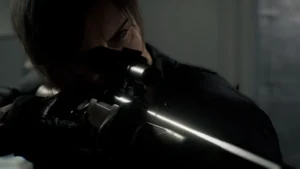
By now, most players already know that Resident Evil Requiem is essentially built around two very different styles of gameplay. On one side is FBI agent Grace Ashcroft, whose sections continue the modern Resident Evil formula focused heavily on immersive first-person horror, psychological tension, and slow-burning fear. On the other hand is longtime series icon Leon S. Kennedy, who appears throughout the story to completely shift the tone with explosive action, larger-than-life set pieces, and the kind of over-the-top heroics fans have come to expect from him.
On paper, this setup sounds dangerously close to the tonal imbalance that divided players during the Resident Evil 6 era. Surprisingly, though, Requiem manages to make the contrast work remarkably well. Instead of clashing against each other, the horror-driven sections and action-heavy moments feel intentionally designed to complement one another, even as the game gradually shifts into increasingly unexpected territory both narratively and visually.
Capcom’s Most Cinematic Resident Evil Yet
No matter where the story eventually goes, one thing remains consistent throughout the experience: Resident Evil Requiem is spectacular from start to finish. This is blockbuster gaming at its absolute highest level — visually stunning, technically polished, and packed with an incredible amount of detail in every scene.
The story is the area where Requiem surprised me most. RE narratives have ranged from brilliantly atmospheric to genuinely ridiculous over the years, and I’ve learned not to expect too much. Requiem’s story is lean, focused, and emotionally effective in a way that feels almost restrained for this franchise. It centres on a small cast of characters in a contained situation, and that focus works in its favour. There’s one reveal about two-thirds of the way through that recontextualises a character I had almost stopped thinking about, and it hit harder than I expected.
The ending is the best the series has had since RE7. I finished it at around 1 am on a weeknight, sat with it for a few minutes, and then immediately went to look up whether anyone else had the same reaction to the final scene that I did. That’s the mark of a story that actually lands.
What truly elevates Requiem, however, is the sheer quality of craftsmanship behind it. Every department — from the designers and engineers to the artists, animators, sound teams, and performers — delivers work that constantly pushes the game’s cinematic ambitions forward. The result is a Resident Evil experience that feels massive in scale while still maintaining the atmosphere, tension, and personality that have defined the franchise for decades.

Resident Evil Requiem trailer. Watch on YouTube
Resident Evil Requiem Delivers Pure Survival Horror
Once Resident Evil Requiem slows down and fully settles into its horror-focused direction, the game transforms into something genuinely terrifying. In fact, there’s a strong argument to be made that this is not only the scariest Resident Evil ever created, but potentially one of the best horror games Capcom has ever produced.
Much of that fear comes from the time spent inside the Rhodes Hill Chronic Care Center, a haunting location that quickly becomes the emotional and atmospheric centerpiece of the game. The facility feels like the closest modern Resident Evil has come to recreating the classic gothic mansion design that defined the franchise’s earliest entries. Dark corridors, unsettling silence, hidden rooms, and an overwhelming sense of dread constantly make exploration feel dangerous.
Capcom gives players only a brief moment to breathe before unleashing the game’s first major threat, and from that point onward, Requiem becomes almost relentlessly tense. The pacing is exceptional throughout these sections, with the developers showing complete control over atmosphere, suspense, and psychological pressure.
One standout moment perfectly captures how effective the horror design truly is. An unsettling rhyme discovered inside a children’s nursery book slowly plants feelings of uncertainty and paranoia long before anything actually happens. Capcom then carefully escalates the tension through a sequence of tightly orchestrated fake-outs, environmental scares, and sudden audio cues until the buildup finally explodes into a terrifying reveal involving a massive claw emerging into view.
Resource management is back in a way that actually matters. I’m used to RE games that feel tight early and then open up once you know where to look. Requiem kept me uncomfortable with my supplies right through to the final third. There were moments where I had to make real decisions about whether to engage an enemy or route around it based purely on how many rounds I had left. Those decisions felt genuinely tense in a way the series hasn’t managed consistently in a long time.
And remarkably, that moment only marks the beginning of what Requiem has in store.
Resident Evil Requiem’s Monsters Are Terrifying And Tragic
The enemy design in Requiem is the best in the series since the original Crimson Heads gave me nightmares as a kid. There’s one recurring creature type that I won’t name because discovering it for the first time is genuinely one of the best horror game moments I’ve had on PC — but the way it moves, the sound it makes, and the specific situation the game puts you in the first time you encounter it is perfectly constructed. I had full health and plenty of ammo, and I still ran. That’s good horror design.
What makes Requiem especially effective is how far it goes to humanize even its most grotesque enemies. Many of the creatures roaming Rhodes Hill still appear trapped inside fragments of their former lives, creating moments that feel eerie, unsettling, and unexpectedly melancholic all at once.
One enormous abomination, far too large for the narrow corridors of the mansion-like facility, painfully squeezes itself through tight hallways just to continue patrolling the building. Elsewhere, zombies endlessly repeat distorted versions of everyday routines from before their deaths. Janitors violently scrub filthy bathrooms as if still performing their duties, orderlies obsessively flick light switches on and off, cooks chase players while clutching sharpened kitchen utensils, and one zombie can even be found sitting at a grand piano, endlessly hammering out a tune.
These details create a bizarre mix of horror, tragedy, and dark absurdity that feels uniquely Resident Evil. At times, the game becomes strangely funny in the most uncomfortable way possible, and that slightly goofy undertone acts as an important bridge between Grace’s terrifying survival horror sections and Leon’s more exaggerated action-driven moments later in the story.
But no matter how surreal or oddly human these monsters may seem at first, the mood instantly changes the moment they begin moving toward you. The second a zombie starts chasing through dark hallways and narrow rooms, Requiem immediately reminds you that beneath all its strange personality and theatrical horror is a game that genuinely wants players to feel vulnerable and afraid.
Stealth And Survival Drive The Horror
The first hour does something clever and slightly cruel. It lets you feel comfortable. The controls are familiar, the opening area is well-lit enough that you’re not constantly on edge, and the first couple of encounters play out exactly like you’d expect from a modern RE game. Then the game takes that comfort and very deliberately dismantles it. I won’t say exactly how, but the moment it happened, I immediately understood that Capcom had been setting me up. Whatever I thought I knew about how this entry played — I was wrong.
The moment my muscle memory failed me was the best thing that could have happened. I spent the next two hours actually scared again. Not jump-scare scared — the deeper, slower kind of scared where you’re moving carefully because you genuinely don’t know what the rules are yet. Requiem gives you that feeling and then slowly, patiently teaches you its own systems. By the time I had a handle on how it wanted to be played, I was completely invested. That onboarding through disorientation is one of the smartest design decisions the series has made in years.
For much of the time spent inside Rhodes Hill, Resident Evil Requiem leans heavily into stealth-focused survival horror. As Grace searches for yet another distant objective hidden somewhere within the sprawling facility, players are frequently forced through painfully claustrophobic environments with very few safe escape routes or opportunities to properly regroup.
This creates a constant rhythm of slow, careful exploration interrupted by sudden moments of panic and desperate escape. Nearly every zombie roaming the facility patrols endlessly through halls, rooms, and corridors, and once they notice Grace, they pursue her with surprising aggression and persistence for as long as they possibly can.
While most enemies lack the overwhelming raw power of Rhodes Hill’s larger monsters, they remain dangerous throughout the game because of how intelligently Capcom maintains tension. Even after Grace gains weapons and becomes more capable, resources remain limited, gunfire attracts additional threats, and enemy pressure never fully disappears.
Capcom constantly finds ways to make confrontation feel risky rather than empowering. Whether through scarce ammunition, oppressive level design, or more sinister mechanics introduced later in the game, Requiem repeatedly pushes players toward stealth as the safest and smartest option.
That design philosophy keeps the fear alive even after players become more experienced, ensuring that every dark corridor and every approaching zombie still carries a genuine sense of danger.
Capcom Keeps The Pressure Constant
Starting from that foundation of nonstop tension, Capcom continuously finds new ways to increase the pressure throughout Resident Evil Requiem. Nearly every mechanic is designed to make players second-guess their decisions and feel constantly uneasy, even during moments that initially appear safe.
Upgrades, for example, often require Grace to collect blood samples from fallen zombies — an idea that immediately creates paranoia, especially when many of those corpses look as though they could suddenly reanimate at any moment. Inventory management adds another layer of stress, with limited storage forcing players to carefully decide which weapons, healing items, and resources are worth carrying and which must be left behind in safe rooms.
That decision-making becomes even more punishing when mistakes force players to backtrack through previously explored areas, extending the danger and exposing Grace to additional threats. For players choosing Classic Mode, the tension rises even further thanks to the return of limited typewriter ribbons, meaning every save becomes a meaningful decision rather than a convenience.
The result is a survival horror experience built entirely around pressure, uncertainty, and resource management. Capcom constantly manipulates pacing and gameplay rules in ways that feel both exhausting and incredibly rewarding at the same time.
Beyond the mechanics themselves, Requiem also excels through its incredible attention to detail. The sound design is exceptional throughout, using distant noises, unsettling ambient effects, and sudden audio cues to maintain anxiety even when nothing is actively happening. Small touches, like the visible trembling in Grace’s hands while aiming her weapon under stress, further strengthen the game’s oppressive atmosphere and make every encounter feel more personal and vulnerable.
All of these elements combine to create an almost overwhelming sense of dread during Grace’s sections. Which is exactly why Leon’s gameplay sequences, presented in the series’s more traditional third-person style, feel like such a deliberate and welcome release of tension whenever they arrive.

Resident Evil Requiem Fully Embraces The Series’ Action Side
Leon Becomes Resident Evil’s Ultimate Action Hero
Leon’s series-spanning journey from fresh-faced twink to world-weary muscle daddy reaches its most exaggerated form yet in Resident Evil Requiem, where he’s essentially reimagined as the ultimate blockbuster action hero. He’s all confidence, sarcasm, and unstoppable energy, delivering the kind of absurd action sequences that only Resident Evil could pull off while still somehow making them work.
From the very first time players hit the melee button and watch Leon casually roundhouse-kick a zombie across the street, it becomes obvious that Capcom is no longer simply acknowledging the franchise’s action-heavy history — it’s fully celebrating it. Whether he’s violently decapitating enemies with hatchets, riding a motorcycle up the side of a skyscraper, or casually batting rocket grenades out of the air, Leon’s sections are pure high-budget action spectacle from beginning to end.
Surprisingly, though, the contrast between Leon and Grace works extremely well during the first half of the game. Their completely different gameplay styles never feel like they’re competing against each other. Instead, the slow, oppressive survival horror of Grace’s sections makes Leon’s explosive action sequences feel even more satisfying, while Leon’s over-the-top momentum helps prevent the game from becoming emotionally exhausting under nonstop horror tension.
A Dramatic Mid-Game Shift Changes Everything
But around the midpoint of Requiem’s roughly 20-hour campaign, the game undergoes such a dramatic tonal shift that it almost feels like an entirely different experience. Once the story leaves behind the haunting atmosphere of Rhodes Hill and moves into the beige destruction of what resembles a large-scale urban war zone, the balance changes significantly.
Without revealing too much, Leon increasingly takes center stage for a large portion of the game, and the pacing shifts heavily toward constant action and larger combat encounters. Even when Grace eventually becomes more involved again later in the story, her gameplay sections adopt a much faster and more aggressive tempo, with only one particularly unsettling late-game sequence fully returning to the slower horror style that defined the opening hours.
To be fair, dramatic tonal changes like this are hardly unusual for Resident Evil. The series has always swung between horror and action, depending on the moment. Still, after such a masterfully constructed first half filled with tension, atmosphere, and psychological dread, the sudden shift can feel genuinely jarring at first.
In some ways, it’s even a little disappointing. The oppressive atmosphere Capcom spent hours carefully building begins to fade once the focus turns toward large-scale action, and it takes time to mentally adjust to what Requiem eventually becomes. Once that recalibration happens, though, the second half still delivers plenty of thrilling moments — just in a very different way from what initially made the game feel so special.
Resident Evil Requiem Feels Like A Celebration Of The Entire Franchise
The Action Evolves Into Pure Resident Evil Chaos
Even after its dramatic tonal shift, Resident Evil Requiem remains incredibly entertaining. The action may move away from the suffocating horror of Rhodes Hill, but the combat continues to shine thanks to its slick, unapologetically over-the-top energy. Leon’s gameplay fully embraces blockbuster action spectacle, gradually handing players an absurdly large arsenal filled with machine guns, pistols, grenades, sniper rifles, and practically every weapon imaginable for turning hordes of undead into chaos as loudly as possible.
The game’s inventory system even evolves alongside this faster pacing. Instead of the more restrictive survival-focused management from Grace’s sections, Leon’s campaign adopts an attaché case system heavily reminiscent of Resident Evil 4. Players are once again forced to carefully organize weapons, ammunition, healing items, and resources into limited space, creating that satisfying balance between action and strategy the series became famous for.
Even with its heavier action focus, Requiem rarely loses its sense of tension. Racing across collapsing rooftops while avoiding mortar fire, surviving brutal ambushes inside cramped environments, and battling increasingly aggressive, heavily armored enemies keep combat constantly intense and exhilarating. It may no longer be pure survival horror, but the pressure never completely disappears.
A Massive Tribute To 30 Years Of Resident Evil
The deeper Requiem progresses, the more obvious it becomes that this is not simply another Resident Evil sequel. It’s a full celebration of the franchise itself as the series enters its 30th anniversary era.
The clues are present from the very beginning, even within the game’s title, but Requiem slowly reveals itself as something much larger than either a straightforward horror game or a pure action experience. Instead, it becomes an enormous tribute to every major era of Resident Evil history.
That celebration appears everywhere throughout the game. It’s there in the sprawling gothic mansion design that recalls the series’ earliest entries. It’s there in the shifting camera perspectives, the dramatic tonal changes, and the way the game constantly moves between horror and action depending on which character is being played.
It’s there in the return of typewriter ribbons, classic-style inventory management, old-school puzzle design, and gameplay systems that directly reference multiple generations of Resident Evil titles. Even Leon’s upgrade mechanics feel heavily inspired by Mercenaries-style progression systems, while the dual-protagonist structure itself recalls the ambitious approach of Resident Evil 6.
Capcom clearly understands the legacy it’s working with, and rather than trying to hide the franchise’s contradictions, Requiem proudly embraces all of them at once. The further the game leans into its own history, the more rewarding it becomes for longtime fans.
An Uneven But Unforgettable Experience
That does create an interesting tension throughout the overall experience. The first half of Requiem feels genuinely groundbreaking as a horror game — arguably one of the strongest survival horror experiences the franchise has ever produced. By comparison, the second half feels far more nostalgic and intentionally retro, trading some of that terrifying innovation for a broader celebration of Resident Evil’s action-heavy past.
As a result, Requiem can absolutely feel uneven at times. There’s a valid argument that the game loses some momentum once its horror atmosphere gives way to larger-scale action and nostalgia-driven spectacle. Certain sections undeniably feel less impactful than the incredible opening hours.
And yet, despite those flaws, it becomes surprisingly difficult to criticize the experience too harshly. There’s something incredibly charming about how confidently Capcom throws together three decades of Resident Evil history into one massive, cohesive package. The game knows exactly what it is, and rather than resisting the franchise’s chaotic identity, it fully embraces it.
My Thoughts
Resident Evil Requiem took me around 12 hours on PC on my first run, and I’m already planning a second playthrough on a greater difficulty. It’s scary in the way the best RE games are scary — not through cheap tricks but through atmosphere, enemy design, and a genuine willingness to make you feel unsafe. If you’ve been waiting for this series to fully deliver again, this is that game. Play it with headphones, in the dark, with no distractions. You’ll regret it and love it at the same time.
Final Score: 9/10 — Resident Evil at its most focused and most frightening. A must-play.
We’ll be covering every new update on kickofdraft.com as it drops — release date, new trailers, gameplay details, indie hits
Bookmark this page and check back.
Source: Steam

Hello! I am Mr. Sano Ethan, a content creator, variety gamer, and the driving force behind Kick Of Draft. With over 6 years of hands-on experience across PC, console, and indie gaming,
Submit your review | |
Pingback: Resident Evil 4 Remake Review: Capcom Rebuilt a Legend and Made It Better - Kick Of Draft
Pingback: Nioh 3 Review: Resident Evil Monsters Meet Sekiro Combat and It Is Absolutely Glorious - Kick Of Draft