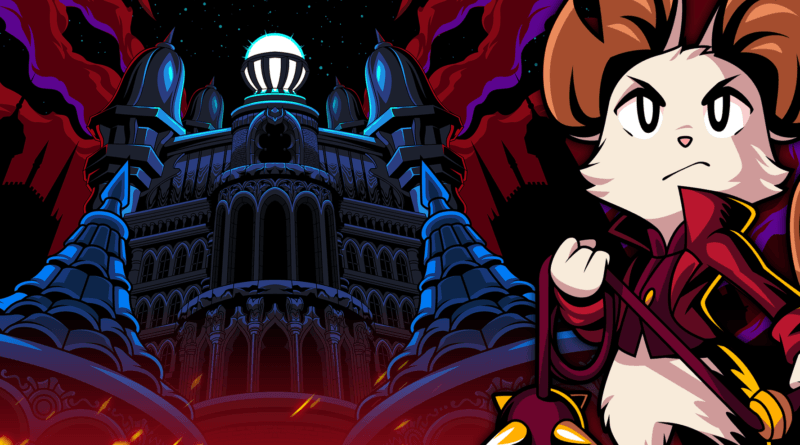
Mina the Hollower Review: Yacht Club Games Did It Again And Nobody Is Talking About It Enough
Mina the Hollower Review: Yacht Club Games Did It Again, And Nobody Is Talking About It Enough
Yacht Club Games built their entire reputation on one game. Shovel Knight launched in 2014, became one of the most beloved indie games ever made, and then spawned so many expansions and spin-offs that it felt like Yacht Club might just be a Shovel Knight studio forever. I didn’t have a problem with that — Shovel Knight is excellent — but there was always a part of me wondering what they would do when they finally stepped away from it and built something completely new. The answer, after years of development and a Kickstarter campaign that raised over a million dollars from people who believed in it, is Mina the Hollower. And as someone who genuinely loves Soulslike games and has a deep affection for retro aesthetics, this game felt like it was made specifically for me. I finished my first playthrough on PC at around 20 hours and immediately started thinking about going back in for everything I missed. That’s the Yacht Club effect. You never really leave.
Mina the Hollower takes the top-down action adventure format of the Game Boy Zelda games — Link’s Awakening, Oracle of Ages, that era — and rebuilds it with a Soulslike difficulty structure underneath the charming retro exterior, and one genuinely brilliant mechanic that makes the whole thing feel distinct rather than derivative. The moment I understood that this wasn’t just a cute retro throwback but a game with real Soulslike teeth underneath it — I was completely sold. The retro aesthetic isn’t just visual either. The way the world is structured, the way secrets are hidden, the way the music feels — all of it captures something about that era of gaming that most modern retro-inspired games chase but never quite catch. Mina catches it.
Here’s what those 20 hours actually felt like — from someone who loves both the genre it’s pulling from and the difficulty it’s embracing.
Who Is Mina and Why Should You Care
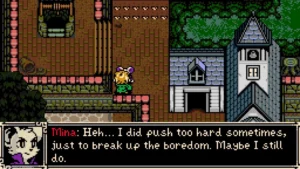
Mina is a technological savant and a Hollower — a designation given to those who specialise in digging and tunnelling through the ground. Her ship runs aground near the island of Morova at the start of the game, pulled off course by something terrible lurking in the water, and from that opening moment, the game establishes its tone completely. This is a Gothic horror world full of monsters, ancient machinery, supernatural threats, and a civilisation that has learned to live alongside danger without ever being truly prepared for it. The story builds from that setup in ways that surprised me consistently — there are twists in this game that I genuinely did not see coming and that reframed things I thought I understood about the world.
The villain is a bat named Thorne — the former head of Baron Lionel’s guard who betrayed the Baron and destroyed the island’s generators alongside his shock troopers. That setup sounds straightforward, but the game layers complexity onto it in a way that makes Mina’s journey feel genuinely meaningful rather than just a sequence of dungeons connected by plot. The story has heart in the same way Shovel Knight’s story had heart — quietly, without making a big deal of it, in the moments between the action rather than the moments of it.
The Hollowing Mechanic Is The Best Idea In The Game
The mechanic that makes Mina the Hollower distinct from every other top-down action adventure on PC is the ability to go underground. Mina can tunnel beneath the surface at any point — moving quickly through the ground, leaping back up to attack, and avoiding most enemy attacks and environmental hazards while underground. It sounds simple,e and it is simple to understand. It takes a long time to fully master, er, and that mastery curve is one of the most satisfying progressions in the game.
In the early hours, urs I used hollowing mostly defensively — ducking underground when things got overwhelming, using it to cross gaps, retreating to the underground safe room called the Underlab when I needed to regroup. By the mid-game, I was using it offensively — tunnelling underneath enemies to reposition, timing underground leaps to hit from unexpected angles, using the movement speed underground to close distances that would have taken too long on the surface. The mechanic opens up completely the better you get at it, and the game is designed to reward that growing mastery at every stage. I was still finding new ways to use it in the final hours.
The one honest criticism I have is that controlling it precisely takes time and patience. There were moments — especially in platforming sections with holes in the floor — where the hollowing mechanic worked against me in ways that felt slightly unfair. A mistimed tunnel exit sent me into a pit more than once when I was trying to do something else entirely. These moments were frustrating in a way that was real rather than the kind of frustration that feels productive. They were infrequent enough that they never broke the experience,e but they were there.
It’s Harder Than It Looks — And That’s The Point
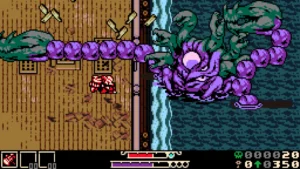
Mina the Hollower looks like a charming retro game about a mouse girl going on an adventure, and it is that — but underneath the charming exterior is a Soulslike difficulty structure that I personally loved and that will absolutely catch you off guard if you go in expecting a relaxed experience. Enemies hit hard. Certain encounters in dungeons are designed to overwhelm you if you approach them recklessly. Boss fights demand pattern recognition and patience rather than just button-mashing. Death sends you back to the last checkpoint with whatever you had at that point. For me, that difficulty was the best part — every death felt like information, every successful boss felt genuinely earned, and the satisfaction of pushing through a hard encounter in Mina hits the same part of my brain that Sekiro and Elden Ring hit. The retro visual style makes the Soulslike difficulty feel even more surprising when it kicks in, and that contrast is part of what makes this game so interesting to experience.
What stops it from feeling punishing is the Trinket system. Trinkets are equippable items that make radical differences to how Mina plays — passive abilities that change her stats, her movement, her recovery, and her damage output. Finding the Trinket that addresses your specific weakness is one of the most exciting things the game produces. I found one early called the Proto Spark that lets you survive a killing blow once before it needs to be reset at a checkpoint — and I kept it equipped for almost the entire game because it gave me exactly the margin for error I needed to push through the harder encounters without getting completely derailed. The Trinket system is the game’s way of letting you shape the difficulty to your playstyle without having a formal difficulty setting, and it works brilliantly.
The World Is Dense With Secrets and Worth Every Minute of Exploration
Morova is one of the best-designed worlds in a top-down action-adventure game I have experienced on PC. Every area has its own visual identity, its own enemy types, its own atmosphere, and its own set of secrets that reward the curious player without ever making you feel like you’re being sent on a scavenger hunt. The game introduces each new major area with a beautifully animated still image showing the region — Mina in the foreground, the distant threat looming behind her — and that framing device gives each area an episodic quality that makes the world feel structured and intentional rather than just a collection of biomes stitched together.
The Halloween aesthetic runs through everything, and it is executed with genuine affection for the source material. Creatures that feel like references to classic horror movie monsters. Environments that feel like they belong to a world that has been navigating supernatural threats for generations. A colour palette that leans into purples, oranges, and deep blues in a way that feels festive and threatening at the same time. I kept stopping to look at things throughout my 20 hours with this game, and that never really stopped feeling rewarding.
Jake Kaufman and Yuzo Koshiro Composed The Soundtrack, and It Shows
Jake Kaufman composed the music for Shovel Knight,t and his work on that game’s soundtrack is one of the main reasons people still talk about it a decade later. He returns for Mina the Hollower alongside Yuzo Koshiro — a composer whose credits include Streets of Rage and ActRaiser — and the result is exactly what you’d hope for from that combination. The soundtrack is atmospheric, thematic, and completely appropriate for the Gothic horror world that the game is building around it. Dungeon themes build tension in exactly the right way. Boss themes hit hard when they need to. The overworld music makes exploration feel like an event rather than a transition between action sequences.
For a game this visually rooted in a retro aesthetic, the music works both as nostalgia and as something genuinely contemporary. It doesn’t feel like a chiptune imitation of something that used to be good — it feels like a composer who understands what made that era of game music great and is applying those principles with modern craft. Some of the tracks from this game have been on my playlist since I finished it. That’s the mark of a great game soundtrack.
Zelda, Dark Souls, Shovel Knight — Does It Earn Those Comparisons?
Every review of Mina the Hollower is going to mention Zelda, Dark Souls, and Shovel Knight because the game wears those influences openly and completely. The honest answer to whether it reaches those heights is — it gets close, and in some specific areas, it does things those games don’t do. The hollowing mechanic is completely original and has no direct equivalent in any of its inspirations. The Gothic horror world is more distinct than anything in the Game Boy Zelda games. The Trinket system handles difficulty customisation in a smarter way than most Soulslike games manage.
Where it occasionally falls short is in the tension between its inspirations. The Soulslike difficulty structure and the Zelda-style exploration don’t always coexist comfortably — there are moments where the Soulslike design choices feel like they’re actively working against the momentum of exploration, and moments where the Zelda structure makes the Soulslike challenge feel less impactful than it should. These are not crippling problems. They are the natural growing pains of a game trying to synthesise two very different design philosophies into something coherent. Mina the Hollower succeeds at that synthesis more often than it fails — but it doesn’t always succeed, and being honest about that matters.
Final Verdict
Mina the Hollower took me around 20 hours on PC for my first playthrough,h and I finished it at 54% exploration, which tells you exactly how much I still have to go back for. The world is dense with secrets, the hollowing mechanic opens up more the better you get at it, and the Trinket system means a second playthrough with a completely different build is already sitting in the back of my mind waiting to happen. Yacht Club Games built something genuinely special here. Not just a nostalgia delivery system — an actual contemporary game that understands what made its inspirations great and applies those lessons with craft and care and a few original ideas of its own.
The difficulty will catch some players off guard, rd and the occasional friction between the Soulslike structure and the Zelda exploration is real. Neither of those things changes what Mina the Hollower fundamentally is — one of the best indie games released in 2026 and the clearest evidence yet that Yacht Club Games is one of the most talented studios in the industry. Shovel Knight made them. Mina the Hollower proves it wasn’t a fluke.
Final Score: 9/10 — A brilliant, charming, and surprisingly demanding action adventure from one of indie gaming’s best studios. Don’t sleep on it.
We’ll be covering every new update on kickofdraft.com as it drops — release date, new trailers, gameplay details, indie hits.
Bookmark this page and check back.

Hello! I am Mr. Sano Ethan, a content creator, variety gamer, and the driving force behind Kick Of Draft. With over 6 years of hands-on experience across PC, console, and indie gaming,
Submit your review | |