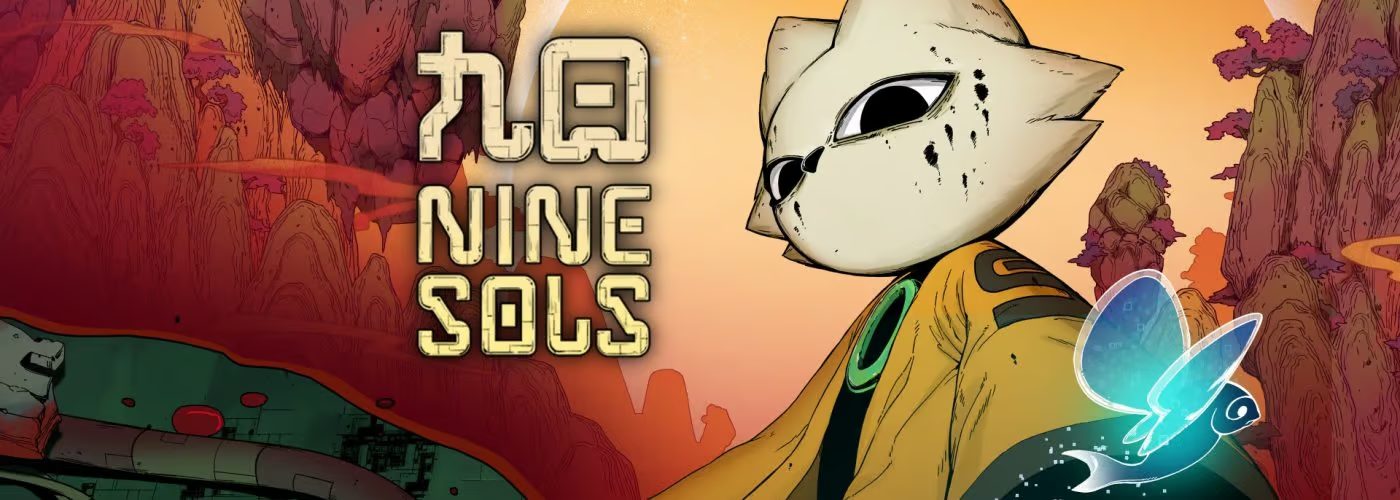
Nine Sols Review :A No-Compromise Action-Platformer of Art and Discipline
A breathtaking journey through pain, discipline, and redemption.
A Metroidvania That Stands Out
I went into Nine Sols expecting a decent indie Metroidvania. What I got was one of the most demanding, beautiful, and emotionally heavy games I’ve played in years. The first hour felt familiar — explore, unlock abilities, backtrack. Then the combat clicked, and everything changed. Nine Sols borrows Sekiro’s parry system and builds an entire identity around it. If you’re not willing to learn enemy patterns with genuine patience, this game will punish you repeatedly and without apology. I was stuck on the first major boss for over two hours. By the end of the game, I was devastated in the best way possible.
Nine Sols is a Metroidvania on the surface, but a Sekiro game at its heart. The exploration, the map, the locked doors you come back to later — all of that is familiar. But the combat is something else entirely. You’re not hacking and slashing your way through enemies. You’re reading them, baiting them, timing a deflect to the exact frame, then punishing with a charged talisman strike. It’s demanding in a way that feels completely intentional, and once you’re inside that rhythm, nothing else feels quite as satisfying.
The Cool World Of Taopunk
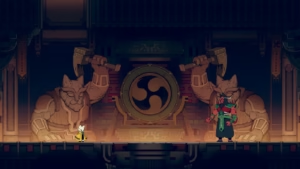
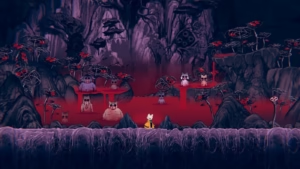
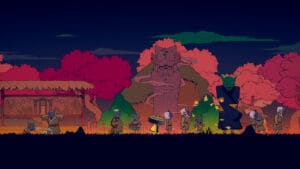
The first time I stepped into a new area and just stopped moving to look around, I knew this game was different. The art in Nine Sols is genuinely stunning — not in a technically impressive way, but in a “who came up with this” way. Ancient temples with neon lighting bleeding through the cracks. Machinery that looks like it grew out of the earth rather than being built on top of it. The developers call the style Taopunk, a mix of Taoist philosophy and cyberpunk aesthetics, and it shouldn’t work as well as it does. But it does.
What makes it land is that nothing feels decorative. Every area has a reason to look the way it looks. The contrast between old and new isn’t just visual style — it’s baked into the story, the world, the characters. I kept screenshotting moments that had no business being as beautiful as they were. A game guide with screenshots this good from a small Taiwanese indie studio is something I genuinely didn’t expect going in.
A Story Of Revenge. Discovery
The story starts simply enough. You’re Yi, an ancient warrior who wakes up after centuries of sleep with one goal — to kill the nine rulers of New Kunlun who wronged him. Classic revenge setup. I wasn’t expecting much beyond that as a narrative framing device. Then, about four hours in, a conversation with one of the Sols completely reframed everything I thought I understood about Yi’s past, and I realised this story was far more interested in making me uncomfortable than making me feel like a hero.
By the midpoint, I had stopped thinking of Yi as the good guy. That’s a genuinely rare thing for an action game to pull off. The writing trusts you to sit with moral ambiguity instead of resolving it cleanly, and the result is a story that stayed with me long after the credits rolled. I finished it late on a weeknight and couldn’t sleep because I kept turning the ending over in my head. That doesn’t happen often.
A Game With A Clear Vision
What struck me most was how uncompromising Nine Sols is. It never softens its difficulty to keep you comfortable. It never rushes its story to keep you engaged. It trusts you to meet it on its own terms. That kind of confidence is rare in any game, let alone an indie title from a studio making its first action game. Most games in this space try to appeal to everyone. Nine Sols is perfectly happy losing you if you’re not the right player for it. That honesty is exactly what makes it special.
The Studio Behind Nine Sols
Red Candle Games built their reputation on horror — Detention and Devotion are two of the most atmospheric narrative games I’ve played on PC. Both were slow, heavy, and deeply rooted in Taiwanese history and folklore. So when Nine Sols was announced as a fast-paced action-platformer, I was genuinely confused. It felt like a total departure. It isn’t. The same care for storytelling, the same commitment to cultural identity, the same refusal to make things comfortable for the player — all of it carried over completely.
What’s remarkable is how confidently they made the jump. Designing combat systems from scratch is a completely different skill set from building psychological horror. Nine Sols’ combat doesn’t feel like a team learning on the job — it feels like a team that studied the best examples in the genre, understood exactly why they work, and then built something that reflects their own creative identity rather than just copying the template. That’s genuinely hard to do, and they pulled it off.
A New Genre, The Same Creative Identity
While Nine Sols belongs to an entirely different genre, many of the qualities that made the studio stand out remain firmly intact. The emphasis on storytelling, the meticulous artistic direction, the integration of cultural symbolism, and the commitment to meaningful world-building all continue to play a central role throughout the experience.
As a result, Nine Sols never feels like a studio attempting to follow a popular trend. Instead, it feels like a group of creators reinterpreting an established genre through their own unique artistic perspective.
Founded in Taipei in 2015, Red Candle Games quickly established itself as a studio interested in creating experiences that extend beyond traditional entertainment. Detention combined psychological horror with Taiwanese folklore and historical themes, while Devotion further demonstrated the team’s ability to tell emotionally complex stories through powerful environmental storytelling and visual design.
Seen through that lens, Nine Sols feels less like a radical departure and more like the natural evolution of a studio eager to explore new forms of expression.
The Importance Of Creative Freedom
Another key aspect of the project is the fact that Red Candle Games chose to self-publish Nine Sols, maintaining complete control over both development and distribution.
For a game so heavily driven by artistic identity and creative ambition, that decision matters. Without the influence of an external publisher, the studio was able to fully pursue its vision without compromise, resulting in a remarkably cohesive final product.
That creative freedom is evident throughout every aspect of the game, from its unusual narrative structure to its distinctive visual style and demanding gameplay systems.
Mastering A Completely New Challenge
Perhaps the most admirable achievement of all is how confidently the studio approaches a genre it had never previously explored.
Transitioning from narrative horror experiences to a mechanically demanding action-platformer is no small task. Designing responsive combat systems, balancing enemy encounters, and creating interconnected exploration-focused environments requires an entirely different skill set.
Yet Nine Sols rarely feels like the work of a studio learning on the job.
The combat system demonstrates a deep understanding of timing, rhythm, player feedback, and progression. Rather than simply borrowing ideas from genre leaders, Red Candle Games clearly studied what makes these systems engaging and successfully adapted those lessons into something that feels uniquely its own.
Building The Taopunk Vision
The studio’s artistic strengths are equally evident in the creation of the game’s now-famous Taopunk aesthetic.
By combining cyberpunk technology, Taoist philosophy, Eastern mythology, traditional architecture, and science-fiction influences, Red Candle Games crafted a world that feels entirely original. The result is a setting that stands apart not only from other metroidvanias but from most modern action games as a whole.
More importantly, the visual design never feels like style for style’s sake. Every artistic choice contributes to the broader themes of spirituality, technology, identity, and cultural heritage that run throughout the narrative.
A Remarkable Display Of Creative Maturity
Self-publishing inevitably comes with challenges, particularly for an independent studio working with limited resources. Yet those limitations appear to have benefited the project rather than hindered it.
Instead of chasing a larger scope or pursuing unnecessary features, Red Candle Games focused its efforts on delivering a polished and cohesive experience built around a clear vision. That attention to detail can be seen throughout every aspect of Nine Sols, from its combat systems and world design to its storytelling and presentation.
Ultimately, Nine Sols serves as a powerful statement about the studio behind it. Red Candle Games didn’t simply prove it could develop a successful game in a completely new genre — it demonstrated that strong creative identity can transcend genre boundaries altogether.
The result is a game that reflects a studio operating with confidence, ambition, and a clear understanding of its own strengths, further establishing Red Candle Games as one of the most exciting independent developers working today.
An Innovative Depth
The plot represents one of the most surprising elements of the entire production, especially considering the genre the title belongs to. Nine Sols chooses to assign its story a central weight, constructing an articulated, layered, and constantly present narrative throughout the entire experience. This is not lore left only in the background or entrusted exclusively to optional descriptions and environmental details, but a genuine active narrative that accompanies and sustains the player’s entire progression.
Yi’s Journey Begins
The story revolves around Yi, an ancient warrior and legendary hero belonging to the Solarian race, awakened after an extremely long period of hibernation in a world that has changed profoundly from the one he knew. The protagonist emerges from this centuries-long sleep driven by a precise objective: to avenge himself against the Nine Sols, the powerful rulers who dominate the city-kingdom of New Kunlun, an enormous suspended metropolis that unites highly advanced technology, spirituality, and monumental architecture in a universe as fascinating as it is decadent.
This narrative premise, apparently linear, develops far more elaborately than the simple “revenge story” structure might suggest. Revenge never functions as a simple superficial engine for the action; instead, it becomes the starting point for a tale that gradually explores Yi’s past, his relationships with the other Sols, the reasons for his fall, and above all, the moral contradictions that lie beneath the central conflict.
A Story Built On Moral Complexity
One of the plot’s most successful aspects is precisely how the game uses narrative progression to slowly deconstruct the player’s initial certainties. What at first appears as a clear and almost archetypal mission reveals itself to be progressively far more complex and morally nuanced.
Every Sol defeated, every new dialogue fragment, every recovered memory contributes to redefining the perception of past events, making the distinction between right and wrong, victim and perpetrator, hero and guilty party increasingly blurred. This is how Yi’s journey transforms into something far more reflective and tragic. The game never paints the protagonist as a pure or uncontestable hero, but as a figure deeply marked by his own past, his own errors, and his own obsessions.
Yi does not fight only against his enemies, but also against the weight of his previous choices, against guilt, and against what the world he helped create has become.
Expanding The World Of New Kunlun
Parallel to the protagonist’s personal story, Nine Sols also develops an extremely rich narrative world-building, gradually constructing the history of Solarian civilisation, the founding of New Kunlun, the motivations that drove the birth of the Nine Sols regime, and the philosophical and ideological tensions running through the game world.
This context considerably broadens the scope of the story, ensuring that the plot never remains confined to simple personal vendetta but expands to touch much larger themes: the relationship between progress and spirituality, immortality and sacrifice, authority and free will.
Narrative Delivery Done Right
Another particularly successful element is how the game distributes narrative information. Despite carrying a narrative component far more explicit than the genre average, Nine Sols never falls into excessive verbal exposition.
The story unfolds through dialogue, cutscenes, memories, environmental interactions, and documents, always maintaining a good balance between direct explanation and progressive discovery. This keeps the story engaging without excessively interrupting the gameplay rhythm.
Themes With Real Emotional Weight
On the emotional front, the plot also distinguishes itself through its surprisingly mature tone. Despite the fantastical and science fiction elements, the story tackles themes of great emotional weight: betrayal, loss, personal failure, moral responsibility, desire for redemption, and the inability to let go of the past.
All of this gives the story a depth rare for the genre and contributes to making many moments along the journey particularly intense.
A Rewarding Narrative For Patient Players
Naturally, this very narrative density can make Nine Sols less immediately accessible than other titles in the same lineage. Players expecting a simple and functional story might find the structure more elaborate and reflective than anticipated. However, for those seeking a genuinely meaningful narrative component within an action-platformer, the title represents one of the most solid and mature offerings of recent years.
It Convinces
A Metroidvania That Prioritises Combat
Critically analysing Nine Sols means engaging with a work that, despite standing out as one of the most solid and surprising productions in the recent indie landscape, is not without limits or potentially divisive choices. Indeed, part of its strength derives precisely from the fact that this is a game extremely conscious of its own identity, its own influences, and the type of experience it wants to deliver. This design confidence often allows it to excel, but at the same time makes it a title a little inclined toward compromise — one that at certain moments can feel selective, demanding, or less accessible than its initial aesthetic appearance might suggest.
One of the first aspects worth reflection concerns its relationship with the metroidvania genre. Despite clearly belonging to this category, Nine Sols frequently shifts its focus so markedly toward technical combat that it partially sacrifices the free, contemplative exploration component many associate with the heart of the traditional metroidvania experience. Exploration is certainly present, well-built, and satisfying, but rarely becomes the dominant element of the experience. The overall feeling is that the game has more interest in using the metroidvania structure as support for combat progression than as the fulcrum of the adventure itself.
A Combat System That Demands Commitment
The combat will either be the best thing about this game for you or the reason you refund it. There is no in between. It’s built entirely around deflection and timing — you cannot tank hits, you cannot out-damage enemies by being aggressive, and you cannot dodge your way through encounters the way you can in most Metroidvanias. I tried all of those approaches in the first few hours and got punished every single time. The game is telling you something very clearly from the start: slow down, watch, and react. Once I actually listened to that, everything opened up.
Boss fights are where this system really shines. Each one is essentially a rhythm puzzle with lethal consequences for getting the beat wrong. I spent almost three hours on one particular boss midway through the game — not out of frustration, but because each attempt taught me something new. The moment I finally beat him, I actually stood up from my chair. I can count on one hand the number of games that have made me do that.
Some Familiarity In The Mid-Game
Another possible criticism concerns the rhythm of narrative and gameplay progression in the central phases. Although the overall balance is very good, there are certain moments where the game tends slightly to reiterate its structure without introducing radical variations.
The quality of the level design and combat system almost always manages to maintain attention, but in certain sections, one can sense a degree of underlying familiarity in the proposed dynamics. This never amounts to true monotony, but the sense of constant mechanical discovery that characterises the first hours does stabilise somewhat as the system reaches its full maturity.
A Narrative Style That Won’t Appeal To Everyone
Nine Sols is not going to appeal to everyone, and it knows that. If you want a chill exploration game or a story you can follow passively while half-watching YouTube, this isn’t it. The game demands your full attention — in combat, in narrative, in the way it builds its world through detail rather than exposition. But if you’re the kind of player who wants a game to actually challenge you and then reward that challenge with something meaningful, Nine Sols delivers that better than almost anything I’ve played on PC in recent years.
Progression That Plays It Safe
The progression system, too, while functional, does not reach the same excellence as other components. Upgrades, secondary abilities, and character customisation options are well-implemented but relatively contained, without offering a huge variety of builds or alternative approaches.
This makes character growth satisfying but less deep than other action-RPG or metroidvania titles that place greater emphasis on build freedom.
A Vision Executed With Confidence
Nine Sols took me about 20 hours to finish on PC, and I spent probably four of those hours on boss fights I had to retry dozens of times. I don’t regret a single one of those attempts. This is a game built with complete conviction by a team that had a clear vision and refused to compromise it. The art is stunning, the combat is the most satisfying I’ve experienced in the genre, and the story genuinely surprised me in ways I didn’t think an indie action game could. If you have any tolerance for challenge and any love for games that treat you like an intelligent adult, play Nine Sols.
Final Score: 9/10 — Unmissable. One of the best indie games on PC right now.
We’ll be covering every new update on kickofdraft.com as it drops — release date, new trailers, gameplay details, indie hits
Bookmark this page and check back.
Source: Steam

Hello! I am Mr. Sano Ethan, a content creator, variety gamer, and the driving force behind Kick Of Draft. With over 6 years of hands-on experience across PC, console, and indie gaming,
Submit your review | |